Modular or Conventional: Choosing a Sewage Treatment Plant.
Both treat sewage. They differ in how they are built, how much space and power they need, and how much looking after they take. Here is how to choose.
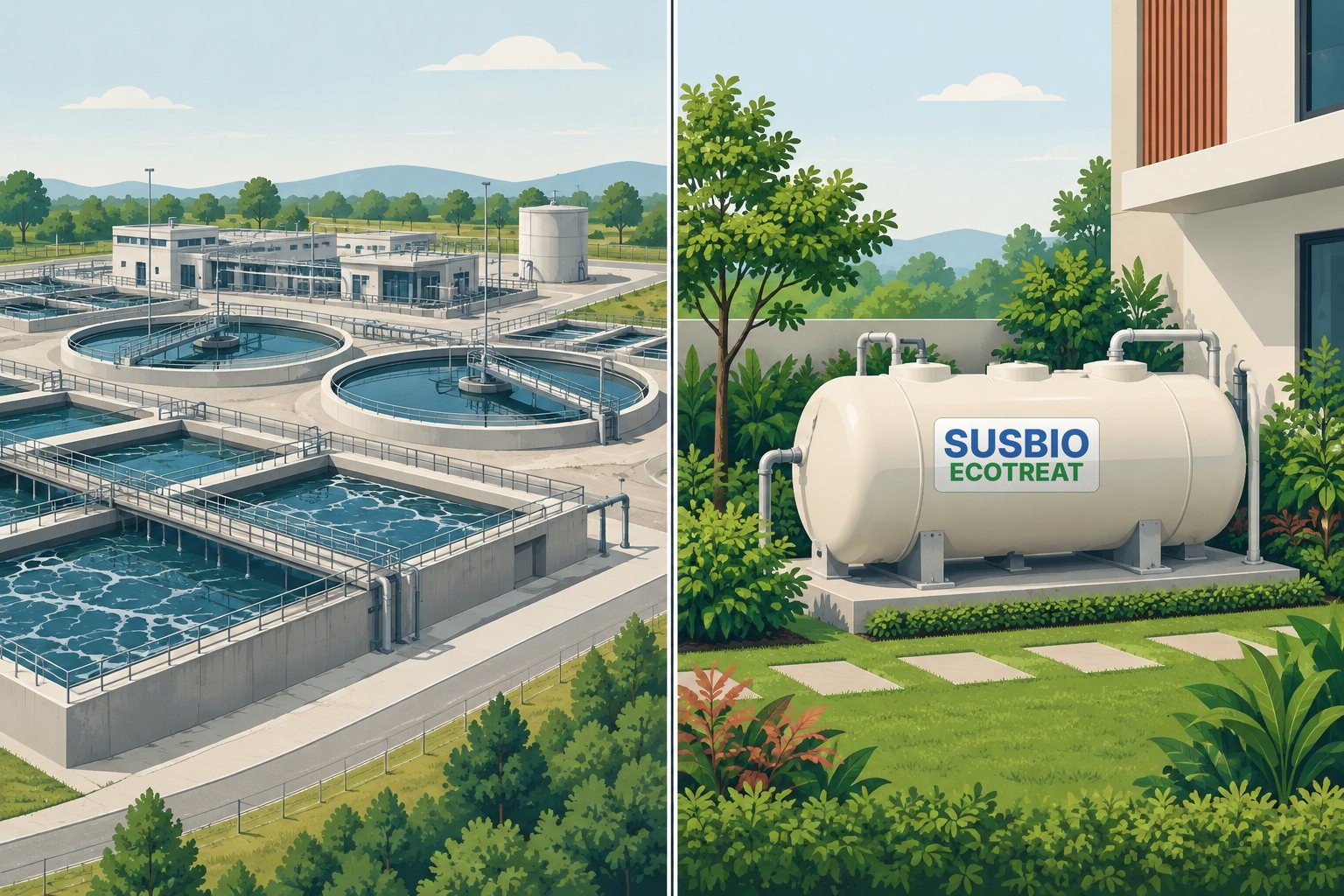 Conventional plantModular plant
What Each One Is
A conventional plant is built on site in concrete, chamber by chamber, over several months.
A modular plant, also called a packaged plant, is built in a factory as one or more ready units, delivered to site and installed.
Side by Side
| Compared | Conventional plant | Modular plant |
|---|---|---|
| Where it is built | On site, in concrete | In a factory |
| Time on site | Months of civil work and concrete curing | About two months from order |
| Space | A chain of open concrete tanks | About half the area; can sit below ground |
| Power | About 1.6 to 2.0 kWh per m³ treated | About 0.8 to 1.2 kWh per m³ at 10 KLD and up; 1.83 kWh a day at 2 KLD (measured) |
| People to run it | A skilled shift operator to tune air and sludge return | Daily checks, plus about half an hour a day to backwash the filters |
| Noise and odour | Roots blowers at 85 to 100 dB(A); open tanks release odour | Blowers under 48 dB each; sealed tank vented through a carbon filter |
| Sludge | Excess sludge every day, to drying beds or a press | Digested in the tank; removed by tanker every 12 to 18 months |
| Growing later | Extend or rebuild | Add another unit |
| Best for | Large flows, above about 200 to 500 KLD, with land away from homes | About 2 to 150 KLD per site: buildings, campuses, hospitals, hostels, hotels |
Modular plant figures: CSIR-NIIST evaluation of a 2 KLD EcoTreat unit, monitored March to April 2026 (report, June 2026), and SUSBIO EcoTreat product information. Conventional-plant figures: typical design ranges from the EcoTreat vs traditional STP technology comparison (October 2026). Download the comparison (PDF)
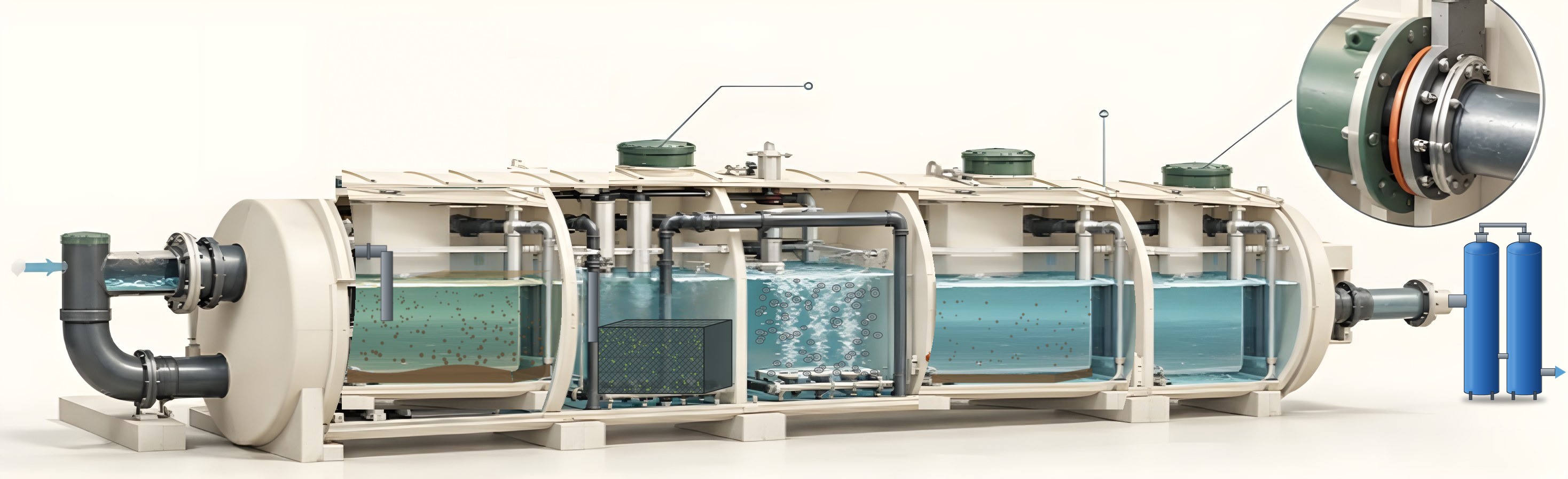
Look Inside a Modular Plant
See What Happens Inside
Four chambers in one tank, then disinfection and filtration. Select a stage to see what it does.
When a Conventional Plant Makes Sense
For very large, steady flows, such as a city's central sewer network, a conventional plant can be the right answer. For most single sites, a modular plant is faster to install and simpler to run.
Questions to Ask Any Supplier
- What standard will the treated water meet, and who tests it?
- Who maintains the plant after the first year, and what does it cost?
- How much power does it draw each day?
- What happens to the sludge, and how often?
- How long from order to a working plant?
- Where can I see one already running?